


 This page is regularly updated, please select here to view the latest version.
Being a Bee Buddy (July 2026)
This extreme heat has us seeking out the shade and a long, cool drink, but how do our insects cope with it? Many species thrive in warmer conditions, but prolonged heatwaves do pose a challenge. Insects may adapt by changing their behaviour to forage when the heat is less intense, and otherwise, shelter in shaded locations. Over time, some populations move further north to find more congenial conditions, such as the Jersey Tiger Moth and the Tree Bumblebee. But as with all species, the rate of Climate Change represents a real threat to many of our insects.

The majority of insects are ectothermic which means that their body temperatures are dependent on external factors and they're unable to self-regulate. Finding shade is their only option for cooling down. And studies have shown that across a range of species, severe heat can damage reproduction rates and survival of offspring. Along with loss of suitable habitat and overuse of pesticides, amongst other things, we are facing a devastating decline in insect numbers.
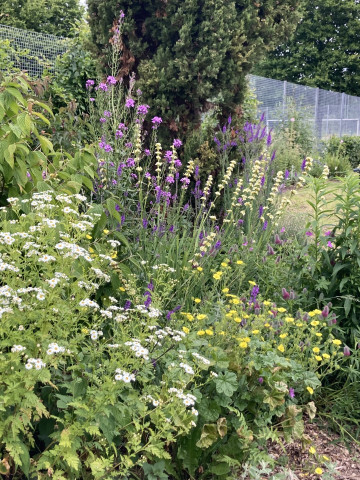
Another problem during prolonged drought is the impact it has on the flowering plants that the insects rely on for their pollen and nectar. If the plant survives at all, the flowers are likely to contain less of these vital ingredients and to go over very quickly. This is one of the main reasons that we continue to water the garden area at the Rec. We feel we are providing a vital lifeline for many insects.
One group of insects that isn't entirely ectothermic, is our Bumblebees. They are what's known as heterothermic, being able to use ambient temperature control, alongside generating their own heat. They achieve the latter by disengaging the flight muscles from the wings and rapidly contracting them to generate heat within the thorax. This is a necessary precursor to flight but also helps them to keep warm in low temperatures. Conversely, they actively cool their nests by fanning their wings at the entrance, even supplementing the effect by adding water inside, and using the 'fanning' to cause it to evaporate.
Unfortunately, Bumblebees are at a further disadvantage in hotter conditions because of their dense covering of hairs. (See photo of Common Carder Bee below) These insects are found mainly in the Northern Hemisphere in temperate regions, where their thick coats help them to conserve heat. Research has shown that activity amongst Bumblebees reduces significantly at 28 degrees and above. Bees stop foraging and concentrate their efforts on trying to keep the nest cool, but are not able to provision it adequately. Anything above 35degrees can result in the nest failing and complete brood mortality.

All pretty grim, to the extent that a group of conservation charities and others, issued a Declaration on UK Insect Declines in 2025. It seems there has been a 60% drop in the number of flying insects in the UK, since 2004. The Declaration goes on to state that "Reversing insect decline is essential, not optional". BUT ALL IS NOT LOST! Everyone of us can do our bit to help Bumblebees and other insects, whether we have a garden, allotment or balcony. It was our primary aim to improve conditions for pollinators at the Rec, when we started to restore the garden in 2019. And our FOPR group of voluntary gardeners meet every week from spring through to December to maintain the habitat and try to ensure their survival
SOME THINGS YOU CAN DO TO HELP OUT IN THE HEAT
1. Plant flowers that are attractive to pollinators. You will need to water them and keep dead heading them to try to encourage them to continue producing more flowers.
2. Provide areas of shade. Leave some areas of long grass, decaying wood, piles of leaves etc
3. Provide a shallow water bowl with pebbles or small sticks to enable the insects to access the water safely. Hedgehogs and birds will also appreciate this.

4. Create a small area of damp soil, preferably close to a solitary bee hotel. Some species seal their egg chambers using wet mud; a scarce resource in this weather (See photo of Red Mason Bee collecting mud for its nest)
_bee.jpg)
5 Create a hoverfly lagoon. Some species of hoverfly need aquatic conditions in which to lay their eggs, such as water-filled rot holes in trees.
These conditions can be easily replicated as their natural habitat declines. (The photo below shows Hoverfly lagoons made by Children's Group last year.)

6. Only use sugared water to revive a bee as a last resort. It provides instant energy but lacks the nutrients and proteins that bees need in their diets. Never use brown sugar or honey, only white sugar and in preference, place the bee on the nearest nectar rich flower.
Advice on all the above can be obtained through a number of conservation groups such as Buglife, The Butterfly Conservation Trust, The Bumblebee Conservation Trust and the Hampshire and Isle of Wight (or other local) Wildlife Trust. Please support them if you can

'IF WE AND THE REST OF THE BACK-BONED ANIMALS WERE TO DISAPPEAR OVERNIGHT, THE REST OF THE WORLD WOULD GET ON PRETTY WELL. BUT IF THE INVERTEBRATES WERE TO DISAPPEAR, THE WORLD'S ECOSYSTEMS WOULD COLLAPSE.' SIR DAVID ATTENBOROUGH
NB All photographs were taken at the Rec, over the past 4 years. Click on each image to englarge it. Words and photos by Denise Long.


Friends of Portswood Rec, Southampton, UK